General Information
The information on these pages should be used to research health risks and to inform the pre-travel consultation.
Travellers should check the Foreign, Commonwealth & Development Office (FCDO) country-specific travel advice page (where available) which provides information on travel entry requirements in addition to safety and security advice.
Travellers should ideally arrange an appointment with their health professional at least four to six weeks before travel. However, even if time is short, an appointment is still worthwhile. This appointment provides an opportunity to assess health risks taking into account a number of factors including destination, medical history, and planned activities. For those with pre-existing health problems, an earlier appointment is recommended.
All travellers should ensure they have adequate travel health insurance.
A list of useful resources including advice on how to reduce the risk of certain health problems is available below
Resources
Vaccine Recommendations
Details of vaccination recommendations and requirements are provided below.
All travellers
Travellers should be up to date with routine vaccination courses and boosters as recommended in the UK according to their age, medical history and individual risks.
Current routine UK vaccination schedule
The travel health consultation provides an opportunity to check whether routine immunisations are up to date such as MMR/MMRV and diphtheria-tetanus-polio vaccines. The following link provides information on the current recommended immunisation schedule recommended in the UK.
Country-specific diphtheria recommendations are not provided here. Diphtheria, tetanus and polio are combined in a single vaccine in the UK. Therefore, when a tetanus booster is recommended for travellers, diphtheria vaccine is also given. In the event of a diphtheria outbreak in a country, specific diphtheria vaccination guidance will be provided.
Vaccination of individuals with uncertain or incomplete immunisation
For individuals with an uncertain or incomplete immunisation history please find guidance for health professionals here Vaccination of individuals with uncertain or incomplete immunisation.
UKHSA provide an immunisation comparison tool for individuals who may have been vaccinated overseas UK and international immunisation schedules comparison tool.
Selective immunisation programmes
Those who may be at increased risk of an infectious disease due to their work, lifestyle choice, or certain underlying health problems should be up to date with additional recommended vaccines. See vaccine recommendations for these groups at the bottom of the 'Complete routine immunisation schedule' document. The individual disease chapters of the 'Green Book' Immunisation against infectious disease provides further details.
Certificate requirements
Please read the information below carefully, as certificate requirements may be relevant to certain travellers only. For travellers further details, if required, should be sought from their healthcare professional.
- There is a risk of yellow fever transmission throughout Nigeria (see 'Most travellers' section below).
- Update August 2025: Personal communication from the National Authority in Nigeria state that Under International Health Regulations (2005), a yellow fever vaccination certificate is now required for all travellers entering or leaving Nigeria. Infants under nine months and adults over 60 years of age are exempted from this requirement. Please note, although some travellers are exempt from the entry requirement, the yellow fever vaccine may still be recommended for personal protection; see 'Most travellers' section below for details.
- This differs to the requirements for Nigeria listed by World Health Organization 2022 (updated in January 2023).
- For now travellers should carry their yellow fever vaccination certificate until further updates are available (see 'Most travellers' section for further details).
- According to World Health Organization (WHO), from 11 July 2016 (for all countries), the yellow fever certificate will be valid for the duration of the life of the person vaccinated. As a consequence, a valid certificate, presented by arriving travellers, cannot be rejected on the grounds that more than ten years have passed since the date vaccination became effective as stated on the certificate; and that boosters or revaccination cannot be required.
- View the WHO list of countries with risk of yellow fever transmission.
- Travellers who intend to visit Nigeria for four weeks or more should be aware that proof of polio vaccination recorded on an International Certificate of Vaccination or Prophylaxis (ICVP) given 4 weeks to 12 months before departure from Nigeria, may be required on exit. Failure to produce an ICVP may result in vaccination on departure. See 'Some travellers' section below for further details.
Most travellers
The vaccines in this section are recommended for most travellers visiting this country. Information on these vaccines can be found by clicking on the blue arrow. Vaccines are listed alphabetically.
Hepatitis A
Hepatitis A is a viral infection transmitted through contaminated food and water or by direct contact with an infectious person. Symptoms are often mild or absent in young children, but the disease can be more serious with advancing age. Recovery can vary from weeks to months. Following hepatitis A infection immunity is lifelong.
Prevention
All travellers should take care with personal, food and water hygiene.
Hepatitis A vaccination
As hepatitis A vaccine is well tolerated and affords long-lasting protection, it is recommended for all previously unvaccinated travellers.
Hepatitis A in brief
Tetanus
Tetanus is caused by a toxin released from Clostridium tetani bacteria and occurs worldwide. Tetanus bacteria are present in soil and manure and may be introduced through open wounds such as a puncture wound, burn or scratch.
Prevention
Travellers should thoroughly clean all wounds and seek medical attention for injuries such as animal bites/scratches, burns or wounds contaminated with soil.
Tetanus vaccination
- Travellers should have completed a tetanus vaccination course according to the UK schedule.
- If travelling to a country or area where medical facilities may be limited, a booster dose of a tetanus-containing vaccine is recommended if the last dose was more than ten years ago even if five doses of vaccine have been given previously.
Country-specific information on medical facilities may be found in the 'health' section of the FCDO foreign travel advice pages.
Tetanus in brief
Typhoid
Typhoid is a bacterial infection transmitted through contaminated food and water. Previous typhoid illness may only partially protect against re-infection.
Vaccination is recommended for most travellers, particularly travellers visiting friends and relatives, those in contact with an infected person, young children, frequent or long-stay travellers visiting areas where sanitation and food hygiene are likely to be poor, and laboratory personnel who may handle the bacteria for their work.
Prevention
All travellers should take care with personal, food and water hygiene.
Typhoid vaccination
- Oral and injectable typhoid vaccinations are available.
Typhoid in brief
Yellow fever
Yellow fever is a viral infection transmitted by mosquitoes which predominantly feed between dawn and dusk, but may also bite at night, especially in the jungle environment. Symptoms may be absent or mild, but in severe cases, it can cause internal bleeding, organ failure and death
Yellow fever in Nigeria
There is a risk of yellow fever transmission throughout this country (see below).
Prevention
All travellers should avoid mosquito bites particularly between dawn and dusk.
Yellow fever vaccination
- Vaccination is recommended for travellers aged 9 months and older.
- See vaccine recommendation map below.
The yellow fever vaccine is not suitable for all travellers, there are specific undesirable effects associated with it. This vaccine is only available at registered yellow fever vaccination centres. Health professionals should carefully assess the risks and benefits of the vaccine, and seek specialist advice if necessary.
Yellow fever in brief
Yellow fever vaccine recommendation map for Nigeria
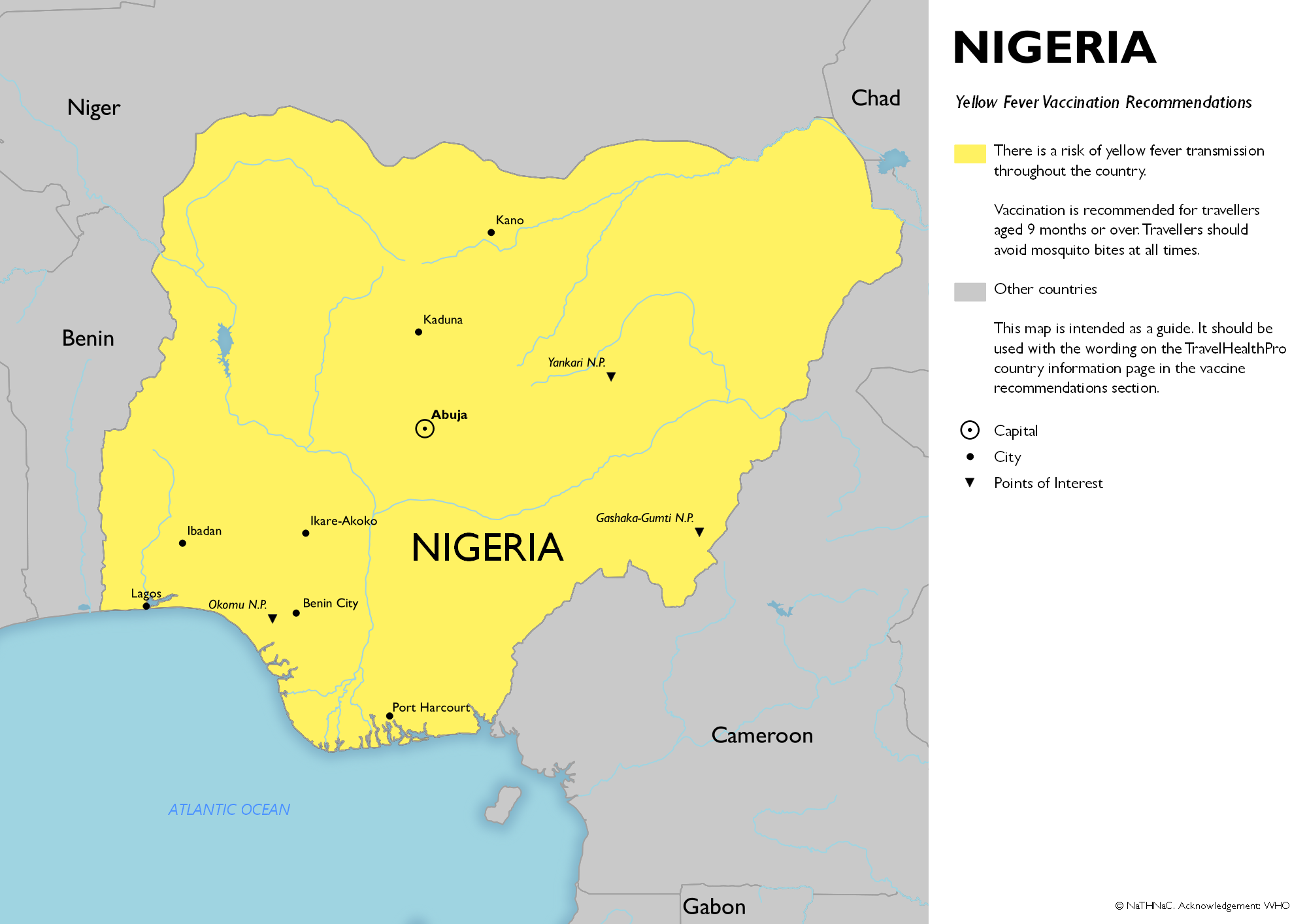
- Click on map to open in a new window
Some travellers
The vaccines in this section are recommended for some travellers visiting this country. Information on when these vaccines should be considered can be found by clicking on the arrow. Vaccines are listed alphabetically.
Chikungunya
Chikungunya is a viral infection spread by mosquitoes which bite mainly during daytime hours. It causes a flu-like illness and can cause severe joint and muscles pains which usually improve in 1–2 weeks but may persist for months or years. It is rarely fatal.
Chikungunya in Nigeria
There is a risk of chikungunya in this country.
Information on current outbreaks, where available, will be reported on our outbreak surveillance database.
Prevention
- Travellers should avoid mosquito bites, particularly during daytime hours.
Chikungunya vaccination
Vaccination may be considered for individuals aged 12 years of age and over who are:
- travelling to regions with a current chikungunya outbreak
- long-term or frequent travellers to regions with an increased risk of chikungunya
- exposed to the chikungunya virus through their work, such as laboratory staff working with the virus
Detailed advice about the use and contraindications of the available vaccines will be available in the green book chikungunya chapter in the coming months. For now, please see our chikungunya in brief page for details.
Chikungunya in brief
Cholera
Cholera is a bacterial infection spread by contaminated food and water. Cholera can cause severe watery diarrhoea, although mild infections are common. The risk of cholera for most travellers is low.
Prevention
All travellers should take care with personal, food and water hygiene.
Cholera vaccination
This oral vaccine is recommended for those whose activities or medical history put them at increased risk of infection or complications. This includes:
- humanitarian aid workers
- persons going to areas of cholera outbreaks who have limited access to safe water and medical care
- other travellers to cholera risk areas, for whom vaccination is considered potentially beneficial (e.g. due to their occupation, activities or underlying health problems)
Cholera in brief
Dengue
Dengue is a viral infection spread by mosquitoes which mainly feed during daytime hours. It causes a flu-like illness, which can occasionally develop into a more serious life-threatening illness. Severe dengue is rare in travellers.
The mosquitoes that spread dengue are more common in towns, cities and surrounding areas.
Dengue in Nigeria
There is a risk of dengue in this country.
Information on current outbreaks, where available, will be reported on our outbreak surveillance database.
Prevention
- Travellers should avoid mosquito bites, particularly during daytime hours.
Dengue vaccination
Vaccination can be considered for individuals aged 4 years of age and older who have had dengue infection in the past and who are:
- travelling to areas where there is a risk of dengue infection or areas with an ongoing outbreak of dengue, or
- are exposed to dengue virus through their work, such as laboratory staff working with the virus
Exceptionally, vaccination can be considered in those who have not had dengue in the past. In these situations, further expert advice should be considered. Detailed guidance on how to ascertain previous infection is available in the UK Health Security Agency Immunisation against infectious disease the 'Green book'. The final decision on vaccination rests with the health professional and the traveller after a detailed risk assessment has been performed and the potential risks of vaccination explained.
Dengue in brief
Hepatitis B
Hepatitis B is a viral infection spread through blood, semen and vaginal fluids. This mostly occurs during sexual contact or as a result of blood-to-blood contact (for example from contaminated equipment during medical and dental procedures, tattooing or body piercing procedures, and sharing of intravenous needles). Mothers with the virus can also pass on the infection to their baby during childbirth.
Hepatitis B in Nigeria
This country is considered to have an intermediate or high prevalence of hepatitis B.
Prevention
Travellers should avoid contact with blood or body fluids. This includes:
- Avoiding unprotected sexual intercourse.
- Avoiding tattooing, piercing, public shaving, and acupuncture (unless sterile equipment is used).
- Not sharing needles or other injection equipment.
- Following universal precautions if working in a healthcare or other higher risk setting.
A sterile medical equipment kit may be helpful when travelling to resource poor areas.
Hepatitis B vaccination
Vaccination could be considered for all travellers and is recommended for those whose activities or medical history put them at increased risk. This includes:
- Those who may have unprotected sex.
- Those who may be exposed to contaminated needles through injecting drug use.
- Those who may be exposed to blood or body fluids through their work (e.g. health and aid workers).
- Those at high risk of requiring medical or dental procedures or hospitalisation e.g. those with pre-existing medical conditions, those who may require travelling for medical care abroad, or those travelling to visit families or relatives.
- Long-stay travellers.
- Those who are participating in contact sports.
- Families adopting children from this country.
Hepatitis B in brief
Measles
Measles is a highly infectious viral illness, spread by airborne or droplet (coughing, sneezing, drops from mouth/nose) transmission. Measles usually starts with cold-like symptoms e.g. fever, cough, runny nose and conjunctivitis (sore, red eyes). This is followed by a blotchy rash starting on the face/head and spreading to the rest of the body.
Complications of measles infection can include ear infections, diarrhoea, pneumonia and convulsions (fits). Life-threatening complications such as encephalitis (brain inflammation) can occur on rare occasions. Measles can have serious consequences especially in children under 1 year of age, immunosuppressed individuals (those with a weakened immune system) and during pregnancy.
Measles in Nigeria
Measles is either 'endemic' (continuous transmission in a 12-month period) and/or the measles risk is assessed to be greater than in the UK due to current outbreaks, conflict, damaged infrastructure, travel-related cases or poor vaccine coverage.
Prevention
All travellers should follow good respiratory hygiene rules and avoid contact with individuals with measles infection.
Measles vaccination
All travellers should make sure they are up to date with the measles, mumps and rubella (MMR) or measles, mumps, rubella and chickenpox (MMRV) vaccines, according to current UK recommendations.
Guidance on vaccinating adults can be found in Measles: the green book chapter – GOV.UK.
Consider early Measles Mumps Rubella (MMR)/Measles Mumps Rubella Varicella (MMRV) vaccination for infants and children.
- Infants from six months of age who are likely to be mixing with local people, should receive a MMR vaccine. The MMRV vaccine can be given from nine months of age if MMR is not available at the time of the appointment.
- Not all children will respond to MMR/MMRV given in the first year of life. When the vaccine has been given before one year of age this dose should be discounted and two further doses of MMR/MMRV should be given at the recommended ages.
- Children who are travelling and have already received one dose of MMR/MMRV at the routine age should have the second dose brought forward to at least one month after the first.
- If a child is given the second dose less than three months after the first dose and is less than 18 months of age, then the routine 18-month dose (which would constitute a third dose) should be given in order to provide optimum protection.
Measles in brief
Meningococcal disease
Invasive meningococcal disease (IMD) is a serious bacterial infection spread by close or direct contact with respiratory droplets from an infected (usually asymptomatic) person, often through coughing and sneezing or sharing cooking utensils. This is usually after lengthy and/or frequent close contact. The most common types of IMD are meningococcal meningitis (infection of the protective lining around the brain) and septicaemia (blood poisoning).
Non-invasive meningococcal disease includes conjunctivitis, which can put the individual traveller (and any of their close contacts) at risk of developing IMD.
Travellers at increased risk include health workers, people visiting friends and relatives and long-stay travellers in close contact with local people.
Meningococcal disease in Nigeria
This country is part of the extended meningitis belt of sub-Saharan Africa.
Prevention
Whenever possible, travellers should avoid overcrowded conditions and follow good respiratory hygiene rules.
Meningococcal disease vaccination
Meningococcal ACWY conjugate vaccine is recommended for travellers whose activities or medical condition put them at increased risk of meningococcal disease, including:
- healthcare workers
- people visiting friends and relatives
- 'rough' travellers such as backpackers
- long-stay travellers who have close contact with local people
- travellers with certain rare immune system problems called complement disorders
- people whose spleen does not work properly (hyposplenia) or who do not have a spleen (asplenia)
Meningococcal disease in brief
Polio
Polio is caused by one of three types of polio virus and is transmitted by contaminated food and water. Previous infection with one type of polio virus does not protect against other types of the virus.
Those at increased risk include travellers who are unvaccinated or under-vaccinated visiting friends and relatives, those in direct contact with an infected person, long-stay travellers, and those visiting areas of poor sanitation.
Polio in Nigeria
This country is infected with circulating vaccine-derived poliovirus type 3 (cVDPV3) with the potential risk of international spread. This country has also reported cases of circulating vaccine-derived poliovirus type 2 (cVDPV2).
Prevention
All travellers should take care with personal and food and water hygiene.
Polio vaccination
- All travellers should have completed a polio vaccination course according to the UK schedule.
- A booster dose of inactivated polio vaccine (IPV) is recommended for the following travellers if they have not had a polio containing vaccine within a year of their planned departure from this country:
- Immunosuppressed individuals and their household contacts, pregnant women, or others for whom live oral polio vaccine is contraindicated, who plan to travel to this country for 4 weeks or more.
- Travellers to settings with extremely poor hygiene (e.g. refugee camps), or likely to be in close proximity with cases (e.g. healthcare workers).
- A booster dose of IPV containing vaccine should also be considered for immunosuppressed individuals travelling for less than 4 weeks to an area with circulating wild or vaccine-derived virus if they have not received a dose within the previous 10 years.
- Polio vaccination should be recorded on an International Certificate of Vaccination or Prophylaxis (ICVP).
- For other travellers who are up to date with their UK schedule, further vaccination is not routinely recommended. Proof of polio vaccination recorded on an ICVP given 4 weeks to 12 months before departure from this country, may be required on exit.
- Failure to produce an ICVP may result in vaccination with live oral polio vaccine on departure. For most individuals, this should cause no problems but those with weakened immune systems (and others for whom live oral vaccine is contraindicated; see above) should NOT receive live oral polio vaccine.
- Supply of International Certificate of Vaccination or Prophylaxis (polio vaccination).
Polio in brief
Rabies
Rabies is a viral infection which is usually transmitted following contact with the saliva of an infected animal most often via a bite, scratch or lick to an open wound or mucous membrane (such as on the eye, nose or mouth). Although many different animals can transmit the virus, most cases follow a bite or scratch from an infected dog. In some parts of the world, bats are an important source of infection.
Rabies symptoms can take some time to develop, but when they do, the condition is almost always fatal.
The risk of exposure is increased by certain activities and length of stay (see below). Children are at increased risk as they are less likely to avoid contact with animals and to report a bite, scratch or lick.
Rabies in Nigeria
Rabies is considered a risk and has been reported in domestic animals in this country. Bats may also carry rabies-like viruses.
Prevention
- Travellers should avoid contact with all animals. Rabies is preventable with prompt post-exposure treatment.
- Following a possible exposure, wounds should be thoroughly cleansed and an urgent local medical assessment sought, even if the wound appears trivial.
- Post-exposure treatment and advice should be in accordance with national guidelines.
Rabies vaccination
A full course of pre-exposure vaccines simplifies and shortens the course of post-exposure treatment and removes the need for rabies immunoglobulin which is in short supply world-wide.
Pre-exposure vaccinations are recommended for travellers whose activities put them at increased risk including:
- those at risk due to their work (e.g. laboratory staff working with the virus, those working with animals or health workers who may be caring for infected patients).
- those travelling to areas where access to post-exposure treatment and medical care is limited.
- those planning higher risk activities such as running or cycling.
- long-stay travellers (more than one month).
Rabies in brief
Tuberculosis
TB is a bacterial infection most commonly affecting the lungs but can affect any part of the body. When a person with TB in their lungs or throat coughs or sneezes they could pass TB on to other people. TB is curable but can be serious if not treated.
The BCG vaccination helps to protect some people, particularly babies and young children who are at increased risk from TB.
Tuberculosis in Nigeria
This country has reported an annual TB incidence of greater than or equal to 40 cases per 100,000 population at least once in the last five years (further details).
Prevention
Travellers should avoid close contact with individuals known to have infectious pulmonary (lung) or laryngeal (throat) TB.
Those at risk during their work (such as healthcare workers) should take appropriate infection control and prevention precautions.
Tuberculosis (BCG) vaccination
BCG vaccine is recommended for those at increased risk of developing severe disease and/or of exposure to TB infection. See UK Health Security Agency Immunisation against infectious disease, the 'Green Book'.
For travellers, BCG vaccine is recommended for:
- Unvaccinated, children under 16 years of age, who are going to live for more than 3 months in this country. A tuberculin skin test is required prior to vaccination for all children from 6 years of age and may be recommended for some younger children.
- Unvaccinated, tuberculin skin test-negative individuals at risk due to their work such as healthcare or laboratory workers who have direct contact with TB patients or potentially infectious clinical material and vets and abattoir workers who handle animal material, which could be infected with TB.
There are specific contraindications to BCG vaccine. Health professionals must be trained and assessed as competent to administer this vaccine intradermally.
Following administration, no further vaccines should be administered in the same limb for 3 months.
The BCG vaccine is given once only, booster doses are not recommended.
Tuberculosis in brief
Malaria
Malaria is a serious illness caused by infection of red blood cells with a parasite called Plasmodium. The disease is transmitted by mosquitoes which predominantly feed between dusk and dawn.
Symptoms usually begin with a fever (high temperature) of 38°C (100°F) or more. Other symptoms may include feeling cold and shivery, headache, nausea, vomiting and aching muscles. Symptoms may appear between eight days and one year after the infected mosquito bite.
Prompt diagnosis and treatment is required as people with malaria can deteriorate quickly. Those at higher risk of malaria, or of severe complications from malaria, include pregnant women, infants and young children, the elderly, travellers who do not have a functioning spleen and those visiting friends and relatives.
Prevention
Travellers should follow an ABCD guide to preventing malaria:
Awareness of the risk – Risk depends on the specific location, season of travel, length of stay, activities and type of accommodation.
Bite prevention – Travellers should take mosquito bite avoidance measures.
Chemoprophylaxis – Travellers should take antimalarials (malaria prevention tablets) if appropriate for the area (see below). No antimalarials are 100% effective but taking them in combination with mosquito bite avoidance measures will give substantial protection against malaria.
Diagnosis – Travellers who develop a fever of 38°C [100°F] or higher more than one week after being in a malaria risk area, or who develop any symptoms suggestive of malaria within a year of return should seek immediate medical care. Emergency standby treatment may be considered for those going to remote areas with limited access to medical attention.
Risk areas
- There is a high risk of malaria in Nigeria: atovaquone/proguanil OR doxycycline OR mefloquine recommended.
Antimalarial recommendations map

- Click on map to open in a new window
Recommended antimalarials
The recommended antimalarials are listed below. If these are not suitable please seek further specialist advice.
Please note, the advice for children is different, the dose is based on body weight and some antimalarials are not suitable.
Atovoquone/Proguanil
Atovaquone 250mg/Proguanil 100mg combination preparation:
- start one to two days before arrival in the malaria risk area
- for adults, one tablet is taken every day, ideally at the same time of day for the duration of the time in a malaria risk area and daily for seven days after leaving the malaria risk area
- take with a fatty meal if possible
- for children paediatric tablets are available and the dose is based on body weight (see table below)
Doxycycline
Doxycycline 100mg:
- start one to two days before arrival in the malaria risk area
- adults and children over 12 years of age take 100mg daily, ideally at the same time of day for the duration of the time in a malaria risk area and daily for four weeks after leaving the malaria risk area
- take with food if possible; avoid taking this drug just before lying down
- not suitable for children under 12 years of age
Mefloquine
Mefloquine 250mg:
- this drug is taken weekly, adults take one 250mg tablet each week
- start two to three weeks before arrival in the malaria risk area and continue weekly until four weeks after leaving the malaria risk area
- for children the dose is based on the body weight (see table below)
Resources
Other Risks
There are some risks that are relevant to all travellers regardless of destination. These may for example include road traffic and other accidents, diseases transmitted by insects or ticks, diseases transmitted by contaminated food and water, or health issues related to the heat or cold.
Some additional risks (which may be present in all or part of this country) are mentioned below and are presented alphabetically. Select risk to expand information.
Biting insects or ticks
Insect or tick bites can cause irritation and infections of the skin at the site of a bite. They can also spread certain diseases.
Diseases in Western Africa
There is a risk of insect or tick-borne diseases in some areas of West Africa. This includes diseases such as African Trypanosomiasis (sleeping sickness), African tick bite fever, Crimean-Congo haemorrhagic fever, leishmaniasis, Rift Valley fever and West Nile virus.
Prevention
- All travellers should avoid insect and tick bites day and night.
- There are no vaccinations (or medications) to prevent these diseases.
Further information about specific insect or tick-borne diseases for this country can be found, if appropriate on this page, in other sections of the country information pages and the insect and tick bite avoidance factsheet.
Influenza
Seasonal influenza is a viral infection of the respiratory tract and spreads easily from person to person via respiratory droplets when coughing and sneezing. Symptoms appear rapidly and include fever, muscle aches, headache, malaise (feeling unwell), cough, sore throat and a runny nose. In healthy individuals, symptoms improve without treatment within two to seven days. Severe illness is more common in those aged 65 years or over, those under 2 years of age, or those who have underlying medical conditions that increase their risk for complications of influenza.
Seasonal influenza in Nigeria
Seasonal influenza occurs throughout the world. In the northern hemisphere (including the UK), most influenza occurs from as early as October through to March. In the southern hemisphere, influenza mostly occurs between April and September. In the tropics, influenza can occur throughout the year.
Prevention
All travellers should:
- Avoid close contact with symptomatic individuals
- Avoid crowded conditions where possible
- Wash their hands frequently
- Practise ‘cough hygiene’: sneezing or coughing into a tissue and promptly discarding it safely, and washing their hands
- Avoid travel if unwell with influenza-like symptoms
- A vaccine is available in certain circumstances (see below)*
*In the UK, seasonal influenza vaccine is offered routinely each year to those at higher risk of developing of severe disease following influenza infection, and certain additional groups such as healthcare workers and children as part of the UK national schedule (see information on vaccination). For those who do not fall into these groups, vaccination may be available privately.
If individuals at higher risk of severe disease following influenza infection are travelling to a country when influenza is likely to be circulating they should ensure they received a flu vaccination in the previous 12 months.
The vaccine used in the UK protects against the strains predicted to occur during the winter months of the northern hemisphere. It is not possible to obtain vaccine for the southern hemisphere in the UK, but the vaccine used during the UK influenza season should still provide important protection against strains likely to occur during the southern hemisphere influenza season, and in the tropics.
Avian influenza
Avian influenza viruses can rarely infect and cause disease in humans. Such cases are usually associated with close exposure to infected bird or animal populations. Where appropriate, information on these will be available in the outbreaks and news sections of the relevant country pages. Seasonal influenza vaccines will not provide protection against avian influenza.
Avian influenza in brief
Outdoor air quality
Poor air quality is a significant public health problem in many parts of the world. Exposure to high levels of air pollution over short time periods (e.g. minutes/hours/days) and longer time periods (e.g. years) is linked to many different acute and chronic health problems. These effects are mainly on the respiratory (lungs and airways) and cardiovascular (heart function and blood circulation) systems.
Current information on world air quality is available from the world air quality index project.
Prevention
Travellers with health problems that might make them more vulnerable to the effects of air pollution who are travelling to areas of high pollution should:
- discuss their travel plans with their doctor, and carry adequate supplies of their regular medication.
- take sensible precautions to minimise their exposure to high levels of air pollution.
- check local air quality data and amend their activities accordingly.
- take notice of any health advisories published by the local Ministry of Health and Department for Environment, and follow the guidance provided.
It is unclear if face masks are beneficial at reducing exposure and may make breathing more difficult for those with pre-existing lung conditions. Those who choose to use one should make sure that the mask fits well and know how to wear it properly.
Outdoor air quality in brief
Schistosomiasis
Schistosomiasis is a parasitic infection. Schistosoma larvae are released from infected freshwater snails and can penetrate intact human skin following contact with contaminated freshwater. Travellers may be exposed during activities such as wading, swimming, bathing or washing clothes in freshwater streams, rivers or lakes.
Schistosomiasis infection may cause no symptoms, but early symptoms can include a rash and itchy skin ('swimmer's itch'), fever, chills, cough, or muscle aches. If not treated, it can cause serious long term health problems such as intestinal or bladder disease.
Schistosomiasis in Nigeria
There is a risk of schistosomiasis in this country.
Prevention
- There is no vaccine or tablets to prevent schistosomiasis.
- All travellers should avoid wading, swimming, or bathing in fresh water. Swimming in adequately chlorinated water or sea water is not a risk for schistosomiasis.
- Drink water that is boiled, filtered or bottled.
- Application of insect repellent before exposure to fresh water, or towel drying after possible exposure to schistosomiasis are not reliable in preventing infection.
- All travellers who may have been exposed to schistosomiasis should have a health check to test for schistosomiasis infection.
Schistosomiasis in brief
Sexually transmitted infections
Sexually transmitted infections (STIs) are a group of viral, bacterial and parasitic infections spread during sexual intercourse or by intimate contact. Certain STIs can be more difficult to treat due to higher levels of antibiotic resistance and some STIs that are rare in the UK may be more common in other world regions.
Anyone who is sexually active is at risk of getting an STI wherever they are in the world.
Risk is higher for travellers who:
- have sex without a condom
- have sex with new or casual partners
- engage in sex tourism
- have sex under the influence of drugs or alcohol
Symptoms of STIs vary depending on the type of infection; some may only cause mild or unnoticeable symptoms. If symptoms do occur, they can include a rash, discharge, itching, blisters, sores or warts in genital and/or anal areas, pain when peeing and flu like symptoms.
If left untreated, STIs can cause serious long term health issues such as fertility problems, pelvic inflammatory disease and pregnancy complications.
Prevention
Using condoms consistently and correctly with new or casual partners is the most effective way to reduce risk of STIs.
Travellers can also reduce their risk of STIs by:
- ensuring they are up to date for all UK recommended vaccines, including if appropriate gonorrhoea, hepatitis B, mpox and human papillomavirus (HPV) vaccines
- considering HIV Pre-Exposure Prophylaxis (PrEP) if appropriate
Travellers should seek medical advice and give their travel history if they think they may have an STI, even if they have no symptoms. They should also have a test for STIs if they have had sex without condoms with a new or casual partner while abroad.
In the UK STI testing is free and confidential.
Zika virus
Zika virus (ZIKV) is a viral infection spread by mosquitoes which predominantly feed during daytime hours. A small number of cases of sexual transmission of ZIKV have also been reported. Most people infected with ZIKV have no symptoms. When symptoms do occur, they are usually mild and short-lived. Serious complications and deaths are not common. However, ZIKV is a cause of Congenital Zika Syndrome (microcephaly and other congenital anomalies) and neurological complications such as Guillain-Barré syndrome.
Zika virus in Nigeria
There is a risk of Zika virus in this country. Details of specific affected areas within this country are not available, but information on current outbreaks where available will be reported on our outbreak surveillance database.
Pregnant women should discuss the suitability of travel and the potential risk that Zika virus may present with their health care provider.
Prevention
- All travellers should avoid mosquito bites, particularly during daytime hours.
- There is no vaccination or medication to prevent Zika virus infection.
- Women should avoid becoming pregnant while travelling in this country, and for 2 months (8 weeks) after their last possible Zika virus exposure* (see below if male partner has travelled).
- If a woman develops symptoms compatible with Zika virus infection, it is recommended she avoids becoming pregnant for a further 2 months following recovery.
- Women who visited this country while pregnant, or who become pregnant within 2 months after their last possible Zika virus exposure*, should contact their GP, obstetrician or midwife for further advice, even if they have not been unwell.
Please note screening of returning travellers without Zika virus symptoms is not available on the NHS. Couples planning pregnancy in the very near future should consider whether they should avoid travel to a country or area with risk of Zika virus, rather than delay conception for the recommended period (see below) after travel. This particularly includes couples in assisted fertility programmes.
Prevention of sexual transmission
Couples should follow guidance on prevention of sexual transmission of Zika virus and avoid conception as follows:
- If both partners travelled, for 3 months after last possible Zika virus exposure.*
- Male traveller only, for 3 months after last possible Zika virus exposure.*
- Female traveller only, for 2 months after last possible Zika virus exposure.*
See further information for pregnant women, their partners and couples planning pregnancy.
*Last possible Zika virus exposure is defined as the later of either the date of leaving a country or area with risk for Zika virus transmission, or the date on which unprotected sexual contact with a potentially infectious partner took place.
See detailed guidance on factors to consider when assessing the risk of Zika virus.
Zika virus in brief
News

Yellow fever update
Yellow fever cases continue to be reported in Africa and South America

Changes to the Country Information pages: Zika
NaTHNaC has reviewed and updated country-specific Zika information and prevention advice

Malaria: a reminder for travellers over the winter holiday season
Advice for travellers and health professionals about malaria

Nigeria: phase out of yellow card
Clarification from Nigeria and the World Health Organization on introduction of the electronic 'yellow card'
Outbreaks
Using information collated from a variety of sources, we regularly review and update information on overseas disease outbreaks and other health issues that may affect the UK traveller.
Please note that not all cases of disease or outbreaks are reported; some diseases may only be reported if they occur outside of the usual recognised risk area or season, or they have been reported in greater than usual numbers.
Further information on the Outbreak Surveillance section.
Cholera in Nigeria
As of 7 October 2026, a total of 68,152 suspected cholera cases and 394 deaths have been reported in Borno State since this outbreak began in May 2026. All 22 local government areas in Borno have now reported cases. Please see our Topics in Brief article for further details on cholera.
Between 1 May 2026 and 18 June 2026, a total of 13,234 cases of cholera (108 deaths) have been reported across 17 local government areas in Borno State. Please see our Topics in Brief article for further details on cholera.
Source: StateBetween 1 January and 24 December 2025, a total of 22,196 cases of cholera (505 deaths) have been reported in Nigeria. Please see our Topics in Brief article for further details on cholera.
Source: ECDCAs of 28 July 2025, 4,700 cholera cases and 113 deaths have been reported in Nigeria during 2025. Please see our Topics in Brief article for further details on cholera.
Source: WHOFrom 1 January 2024 to 29 September 2024, Nigeria has reported a total of 10,837 cholera cases, and 359 deaths, across 35 states and the Federal Capital Territory.
Source: WHOBorno
Kano
Katsina
Sokoto
Diphtheria in Nigeria
Between 1 January and 23 August 2026, a total of 16,997 cases of diphtheria and 596 deaths have been reported. Most cases have been reported from Kano, Bauchi, Katsina, Borno and Sokoto states. Please see our Topics in Brief article for further details on diphtheria.
Lassa fever in Nigeria
As of 23 August 2026, a total of 1,056 confirmed Lassa fever cases, with 7,580 suspected cases, six probable cases and 253 deaths, have been reported across 24 states in Nigeria for 2026. Please see our Topics in Brief article for further details on Lassa fever.
As of 12 July 2026, a total of 963 confirmed Lassa fever cases, with 6,554 suspected, six probable cases and 229 deaths, have been reported across 23 states in Nigeria for 2026. Please see our Topics in Brief article for further details on Lassa fever.
Source: StateAs of 10 May 2026, a total of 793 confirmed Lassa fever cases, with 5,034 suspected, five probable cases and 204 deaths, have been reported across 23 states in Nigeria for 2026. This includes 45 cases in health workers. Please see our Topics in Brief article for further details on Lassa fever.
Source: StateIn 2026, up to 29 March, 3,831 suspected, 663 confirmed and five probable cases, and 167 deaths have been reported across 22 states. Of all confirmed cases 85% were reported from five states (Bauchi, Ondo, Taraba, Edo and Benue). Please see our Topics in Brief article for further details on Lassa fever.
Source: StateAs of 22 February 2026, a total of 1,989 suspected Lassa fever cases (404 confirmed, 43 deaths) have been reported since the start of 2026. Confirmed cases have been reported in 18 states, with 84% of confirmed cases reported from Ondo, Bauchi, Edo and Taraba. Please see our Topics in Brief article for further details on Lassa fever.
Source: StateAs of 14 December 2025, a total of 9,164 suspected Lassa fever cases (1,097 confirmed with 201 deaths) have been reported since the start of 2025. Confirmed cases have been reported in 21 states, with 89% of confirmed cases reported from Ondo, Bauchi, Edo and Taraba. Please see our Topics in Brief article for further details on Lassa fever.
Source: StateBetween 1 January and 16 November 2025, a total of 8,679 suspected Lassa fever cases (995 confirmed and 184 deaths) have been reported. Cases have been reported from 21 states with 88% of confirmed cases from the states of Ondo, Bauchi, Edo and Taraba. Please see our Topics in Brief article for further details on Lassa fever.
Source: StateBetween 1 January and 14 September 2025, a total of 7,673 suspected Lassa fever cases (895 confirmed and 166 deaths) have been reported. Cases have been reported from 21 states, and 90 percent of confirmed cases are from the states of Ondo, Bauchi, Edo, Taraba and Ebonyi. Please see our Topics in Brief article for further details on Lassa fever.
Source: StateBetween 1 January and 13 July 2025, a total of 6,520 suspected Lassa fever cases (811 confirmed and 152 deaths) have been reported. Cases have been reported from 21 states this year, 89 percent of confirmed cases are from Ondo, Taraba, Bauchi, Edo, and Ebonyi states. Please see our Topics in Brief article for further details on Lassa fever.
Source: StateAs of 29 June 2025, a total of 6,109 suspected cases of Lassa fever, (790 confirmed) including 148 deaths have been reported in Nigeria during 2025. 20 states have reported at least one case, the majority from Bauchi, Taraba and Ondo states. Please see our Topics in Brief article for further details on Lassa fever.
Source: StateAs of 18 May 2025, a total of 5,118 suspected cases of Lassa fever, (733 confirmed) including 141 deaths have been reported in Nigeria during 2025. 18 states have reported at least one case, the majority from Bauchi, Taraba and Ondo states. Please see our Topics in Brief article for further details on Lassa fever.
Source: StateAs of 30 March 2025, a total of 3,779 suspected cases of Lassa fever, (659 confirmed) including 122 deaths have been reported in Nigeria during 2025. 18 states have reported at least one case, the majority from Bauchi, Edo and Ondo. Please see our Topics in Brief article for further details on Lassa fever.
Source: StateAs of 23 February 2025, 2,492 suspected cases of Lassa fever, (506 confirmed) and 6 deaths have been reported in Nigeria in 2025. 12 states have reported at least one case, the majority from Bauchi, Edo and Ondo. Please see our Topics in Brief article for further details on Lassa fever.
Source: StateBetween 12-19 January 2025, 359 suspected and 71 confirmed cases and 17 deaths from Lassa fever have been reported. In 2025, 10 states have reported at least one case, the majority from Bauchi, Edo and Ondo. Please see our Topics in Brief article for further details on Lassa fever.
Source: StateAs of 16 December 2024, a total of 10,450 cases, including 184 deaths, of Lassa fever have been reported in 28 of 36 states and the federal capital district during 2024. Please see our Topics in Brief article for further details on Lassa fever.
Source: Africa CDCAs of 6 September 2024, a total of 9,256 cases of Lassa fever (1,005 confirmed and 8,251 suspected) have been reported from 28 of 36 states and the federal capital territory this year.
Source: Africa CDCAs of 22 April 2024, 5,669 suspected, 832 confirmed and 17 probable cases, including 152 deaths, have been reported. In total for 2024, 27 states have recorded at least 1 confirmed case across 126 Local Government Areas.
Source: StateSince the beginning of 2024, 1,995 cases and 68 deaths have been reported in Nigeria.
Source: StateAs of 18 January 2024, in the first week of 2024, 53 confirmed cases have been reported from 9 states, including 6 deaths. This compares to 29 confirmed cases (including 8 deaths) reported from 6 states in the first week of 2023. Cumulatively, 9,155 suspected cases, 1,270 confirmed cases and 227 deaths were reported for 2023 (across 28 states and 124 LGAs).
Source: StateAs of 16 June 2023, 5,822 suspected and 957 confirmed cases of Lassa Fever, including 164 deaths among confirmed cases, have been reported. Cases have been confirmed in 28 States across 106 Local Government Areas.
Source: StateAs of 7 May 2023, in total for 2023, 28 States have recorded at least one confirmed case of Lassa fever across 106 Local Government Areas.
Source: StateAs of 16 April 2023, a total of 4,702 suspected, 5 probable and 877 confirmed cases of Lassa fever have been reported since the start of the year. Among the confirmed cases, there have been 152 deaths. Cases have been reported from 101 local government areas, in 26 out of 36 states, including the Federal Capital Territory.
Source: WHOAs of 30 January 2023, the Nigerian authorities have stated that there is an unprecedented upward trend in confirmed Lassa fever cases, compared to previous years. A total of 244 confirmed cases, with 37 deaths, have been reported in 2023, with an increased risk of healthcare worker infections and deaths.
Source: StateAs of 2 October 2022, cumulatively from week 1 to week 39 in 2022, 933 confirmed cases including 173 deaths have been reported. The majority of cases are from Ondo State, the others from Edo and Bauchi States.
Source: StateBetween 1 January and 13 March 2022, a total of 630 laboratory confirmed Lassa fever cases including 112 deaths have been reported across 23 states.
Source: StateFrom 3 to 30 January 2022, 211 laboratory confirmed Lassa fever cases including 40 deaths have been reported in 14 states.
Source: WHOBetween 1 and 16 January 2022, a total of 96 confirmed cases of Lassa fever, with 11 deaths have been reported across 11 states. Of all confirmed cases most were reported from Edo, Ondo and Bauchi states.
Source: WHODuring 2021, a total of 510 cases of Lassa fever with 102 deaths have been confirmed across 17 states. Of all confirmed cases, most were reported in Edo , Ondo and Bauchi states.
Source: WHOBetween 1 January and 12 September 2021, a total of 3,006 suspected cases of Lassa fever were reported with 369 confirmed and 76 deaths. Of all confirmed cases, 84% are from Edo (45%), Ondo (34%) and Taraba (5%) States.
Source: WHOA total of six new confirmed cases were reported from four states (Ondo, Edo, Bauchi and Ebonyi) in the week ending 27 December 2020. From 1 January to 27 December 2020, a total of 1,195 cases (1,181 confirmed and 14 probable) with 244 deaths were reported across 27 states in Nigeria.
Source: WHOAs of 11 October 2020, a total of five new confirmed cases of Lassa fever with one death were reported from three states - Ondo (three cases with one death), Edo (one case), and Ebonyi (one case) in week ending 11 October 2020. So far this year, a total of 1,117 cases (1,103 confirmed and 14 probable) with 242 deaths have been reported from 129 Local Government Areas across 27 states in Nigeria.
Source: WHOAs of 14 March 2020, a total of 3,735 suspected Lassa fever cases, 906 confirmed cases and 161 deaths have now been reported in 2020. A total of 27 States have now recorded at least one confirmed Lassa fever case in 2020.
Source: Nigerian Centre for Disease ControlThe outbreak of Lassa fever is rapidly expanding, with the number of new reported cases increasing weekly and new states being affected. Between 1 January and 2 February 2020, a total of 1,226 suspected cases were reported. Among these, a total of 365 confirmed cases were recorded from 23 states. The majority of confirmed cases are from Edo (35%), Ondo (35%) and Ebonyi (6%) states. Among the 365 confirmed cases, 47 deaths have occurred.
Source: WHOBetween 1 and 19 January 2020, a cumulative total of 398 suspected cases of lassa fever was reported nationally. Among these, a total of 163 confirmedcases was identified from 32 Local Government Areas. 793 confirmed cases were reported in 2019.
Source: WHOAs of 1 December 2019, a total of 793 confirmed (and 19 probable) Lassa fever cases have been reported from 23 states since 1 January 2019.
Source: StateAs of 12 May 2019, a total of 569 confirmed cases and 128 deaths, have been reported from 21 states.
Source: StateBetween 1 January and 3 March 2019, a total of 420 confirmed cases, including 93 deaths, have been reported from 21 states.
Source: StateFrom 1 January to 10 February 2019, 327 cases of Lassa fever (324 confirmed and 3 probable) with 72 deaths have been reported across 20 states and the Federal Capital Territory. The majority of cases were reported from Edo (108) and Ondo (103) states. Twelve cases have been reported among healthcare workers in seven states.
Source: WHOOn 22 January 2019, the Nigeria Centre for Disease Control (NCDC) declared an outbreak of Lassa fever in the country. From 1 January to 27 January 2019, a total of 213 confirmed and two probable Lassa fever cases, with 42 deaths have been reported across 40 local government areas in 16 states.
Source: WHOFrom 1 - 20 January 2019, a total of 136 confirmed cases have been reported across nine states.
Source: WHOFrom 1 January to 13 January 2019, there were 60 confirmed cases. As of the 6 January, eight states (Edo, Ondo, Bauchi, Nasarawa Ebonyi, Plateau, Taraba and FCT) have recorded at least one confirmed case.
Source: StateBetween 1 January 2018 to 2 December 2018, a total of 3229 suspected cases have been reported: 581 confirmed, 17 probable and 2631 negative. A total of 164 deaths have been reported: 147 confirmed cases, and 17 in probable cases. 9193 contacts have been identified from 23 states and are being followed up.
Source: StateAs of 20 April 2018, WHO advises that from 1 January to 15 April 2018, a total of 1,849 suspected cases have been reported: 413 confirmed, nine probable, 1,422 negative and were classified as non cases, and five with laboratory results are pending. 114 deaths have been reported. 27 health workers have been infected since 1 January 2018, with eight deaths.
Source: WHOBetween 1 January and 8 April 2018, a total of 1,781 suspected cases have been reported from 20 states: 408 confirmed, nine probable, 351 negative and 13 awaiting results. 27 health workers, with six deaths, have been affected since the start of this outbreak.
Source: StateAs of 23 March 2018, a cumulative total of 1,495 cases (376 confirmed) with 119 deaths have been reported January through 18 March 2018 across 19 states: Anambra, Bauchi, Benue, Delta, Ebonyi, Edo, Ekiti, Federal Capital Territory, Gombe, Imo, Kaduna, Kogi, Lagos, Nasarawa, Ondo, Osun, Plateau, Rivers, and Taraba. Healthcare workers have been affected during this outbreak (17 cases with four deaths).
Source: WHOAs 11 March 2018, a total of 1,386 cases (365 confirmed) with 114 deaths have been reported since December 2017 across 19 states: Edo, Ondo, Bauchi, Nasarawa, Ebonyi, Anambra, Benue, Kogi, Imo, Plateau, Lagos, Taraba, Delta, Osun, Rivers, FCT, Gombe, Ekiti, and Kaduna. Among the cases are 16 healthcare workers.
Source: StateAs of 4 March 2018, a total of 1121 suspected cases (353 confirmed, 8 probable and 37 awaiting laboratory results) with 110 deaths have now been reported.
Source: StateAs 25 February 2018, a total of 1,081 cases (317 confirmed) with 72 deaths have been reported since December 2017 across 18 states: Edo, Ondo, Bauchi, Nasarawa, Ebonyi, Anambra, Benue, Kogi, Imo, Plateau, Lagos, Taraba, Delta, Osun, Rivers, FCT, Gombe, and Ekiti. Among the cases are 14 healthcare workers.
Source: StateAs 18 February 2018, a total of 913 cases (272 confirmed) with 59 deaths have been reported since December 2017 across 17 states: Edo, Ondo, Bauchi, Nasarawa, Ebonyi, Anambra, Benue, Kogi, Imo, Plateau, Lagos, Taraba, Delta, Osun, Rivers, FCT, and Gombe. Among the cases are 14 healthcare workers.
Source: StateAs 11 February 2018, a total of 615 cases (193 confirmed) with 57 deaths have been reported since December 2017 across 17 states: Edo, Ondo, Bauchi, Nasarawa, Ebonyi, Anambra, Benue, Kogi, Imo, Plateau, Lagos, Taraba, Delta, Osun, Rivers, FCT, and Gombe. Among the cases are 14 healthcare workers.
Source: StateBetween 1 January and 4 February 2018, nearly 450 suspected cases were reported, of which 132 are laboratory confirmed Lassa fever. Of these, 43 deaths were reported, 37 of which were lab confirmed. Cases have been reported in 17 states.
Source: WHOAs of 28 January 2018, a total of 297 cases (77 confirmed) with 21 deaths have been reported in thirteen states (Edo, Ondo, Bauchi, Nasarawa, Ebonyi, Anambra, Benue, Kogi, Imo, Plateau, Lagos, Taraba and Delta) between 1 and 28 January 2018. Ten healthcare workers are among the cases (10) and deaths (4).
Source: StateAs of 24 January 2018, a total of 107 cases (61 confirmed) with 16 deaths have been reported in ten states (Edo, Ondo, Bauchi, Nasarawa, Ebonyi, Anambra, Benue, Kogi, Imo, Lagos) between 1 and 21 January 2018. Ten healthcare workers are among the cases (10) and deaths (3).
Source: StateOn 15 January 2018, four cases of Lassa fever in health workers, with three deaths, were confirmed.
Source: StateAs of 24 December 2017, a total of 1,022 suspected cases and 127 deaths have been reported since December 2016. The outbreak is active in six states: Ondo, Edo, Plateau, Bauchi, Kaduna, and Nasarawa.
Source: StateAs of 3 March 2017, the first case in Borno State since 1969 has been reported.
Source: WHODengue in Nigeria
As of June 2026, a total of 95 (nine confirmed) dengue cases have been reported in Nigeria for 2026. Please see our Topics in Brief article for further details on dengue.
Health authorities in Nigeria state that a total of 735 (219 confirmed) dengue cases, with two deaths, were reported between January and November 2025. Most cases were reported in Edo (537 cases) and Sokoto (96 cases) states. Please see our Topics in Brief article for more details on dengue.
Source: StatecVDPV3 in Nigeria
As of 4 March 2026, a case of circulating vaccine-derived poliovirus type 3 (cVDPV3) has been reported with an onset of paralysis reported on 3 January 2026. Five cases of cVDPV3 were reported in Nigeria during 2025. Please see our Topics in Brief article for further details on polio.
Map

Foreign travel advice

Help us to adapt a Travel Health Resource for UK Travellers

Take part in a study that aims to help UK travellers make informed choices about Japanese encephalitis (JE) vaccination.
Find out moreGet TravelHealthPro on your site

Integrate features of TravelHealthPro into your own website with our API and widget